
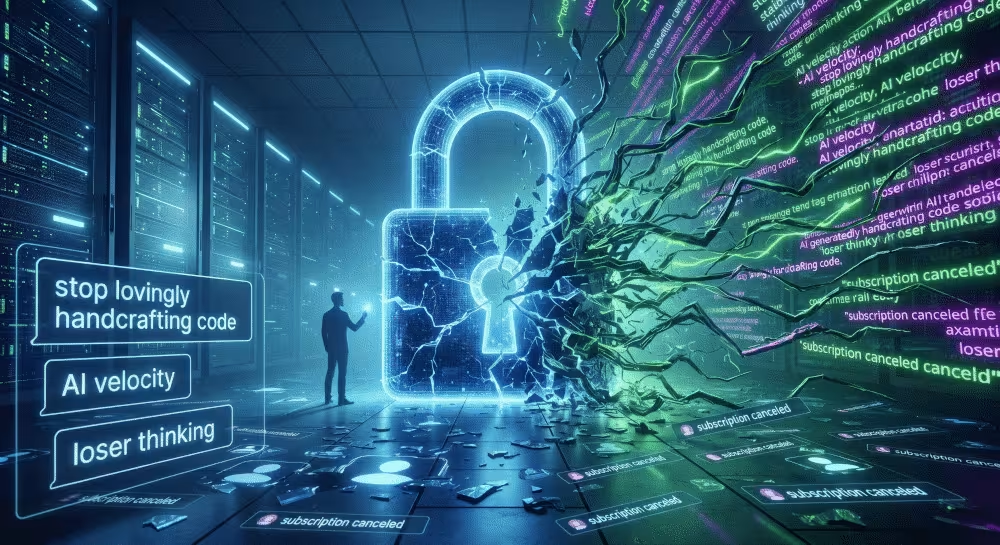
Proton built an empire on a simple promise: highly secure, private, human-audited technology that stood as the antithesis to Silicon Valley's data-hungry giants. For years, privacy advocates happily paid a premium for the Swiss company’s email and drive services to escape the tracking and unchecked automation of big tech. Today, that reputation is rapidly unraveling.
Following a bombshell investigative report by Joseph Cox at 404 Media on October 29, 2026, the public facade of Proton has shattered. Leaked internal Slack communications reveal a leadership team in the grip of what employees are calling "AI psychosis," aggressively pushing untested, AI-generated code into production while actively penalizing engineers who prioritize security. For a company whose entire brand is built on uncompromising privacy, the pivot has sparked a mass exodus of its core user base.
The Illusion of Handcrafted Security
Consumers migrating to privacy-focused platforms expect software that is deliberately crafted, rigorously audited, and slowly released to ensure zero vulnerabilities. Instead, the leaked internal documents reveal that Proton has traded deliberate engineering for breakneck speed.
In October 2026 alone, internal sources reported that 90% of the company's code was generated by Anthropic's Claude. When engineers pushed back against this rapid deployment—specifically requesting more time to run vital penetration tests before releasing new features to the public—CEO Andy Yen dismissed the caution as "loser thinking." Leadership's newly stated priority is velocity: pushing out as many features as possible to drive sign-ups, explicitly instructing staff to stop "lovingly handcrafting" code.
A Hostile Mandate for "AI Velocity"
The internal culture at Proton has reportedly grown highly toxic for any engineer attempting to uphold the security standards the company advertises. Leadership mandated that staff transition to workflows where AI writes and checks the code, leaving human engineers as mere observers.
To enforce this, Proton set up an internal whistleblowing email address, encouraging employees to report colleagues who "stand in the way of AI velocity." Leadership promised to "relentlessly smash" any internal opposition to the AI rollout. The company even went so far as to begin "re-interviewing" its own engineering staff this week to test their willingness to comply with the AI mandates—a deeply coercive tactic that Yen only canceled after the 404 Media article sparked severe public backlash on platforms like Reddit.
The Consumer Bait and Switch
The exodus from Proton comes down to a fundamental breach of trust. Users are realizing they are paying a premium for a human-audited privacy shield, but are actually receiving experimental, unvetted "AI slop."
If AI generates a vulnerability in a standard consumer app, it is a bug. If AI generates a vulnerability in an end-to-end encrypted email service used by journalists, activists, and privacy-conscious enterprises, it is a catastrophic failure. By forcing rapid AI deployment over diligent security testing, Proton has demonstrated that it is willing to treat its paying users as beta testers for its profit margins.
The Self-Hosting Renaissance
The collapse of trust in Proton highlights a broader realization within the privacy community: you cannot outsource your data security to a closed SaaS platform, no matter how good their marketing is. Corporate ethics can pivot overnight based on a single CEO's whims or the sudden pressure to maximize profit through automation.
This controversy is accelerating a massive market shift toward transparent, open-source, and self-hosted infrastructure. Organizations and tech-savvy users are increasingly abandoning managed privacy subscriptions in favor of spinning up their own environments. By utilizing robust open-source frameworks and hosting their own project management, communication, and file-sharing tools on private servers, businesses are reclaiming total ownership of their data. In an era where commercial software vendors are racing to replace human oversight with unchecked AI, self-hosting has become the only verifiable way to guarantee that a platform’s code—and its priorities—remain secure.